25 Thompson Rd, Branford, CT 06405  |  Mon–Fri 8am–5pm 800.243.3161  |  100% Woman-Owned · Est. 1947
Product Category

Coiled Cords

UL-listed coiled cords, sold across the industry as coil cords, with self-retracting helical geometry. From miniature signal cords for instrumentation to shielded multi-conductor cable for industrial control. Engineered and manufactured in Branford, CT since 1947.

Shielded & Miniature Coiled Cords

Autac coiled cords deliver signal integrity and compact flexibility where it matters most. From EMI-protected shielded lines to ultra-compact miniature cords, every product is built to perform. If you are sourcing a coil cord by wire gauge, conductor count, or shield type, this is the range to work from.

🛡

Shielded Cords for EMI Protection

Spiral-wrap and foil shielding options provide 90%+ coverage for electromagnetic interference protection. Available in PVC and Auta-Prene jacketing with individually served shielded conductors for maximum noise rejection in sensitive signal and data applications.

🔌

Miniature Cords for Tight Spaces

Ultra-compact coiled cords with small OD profiles for instruments, medical devices, and electronics where space is at a premium. Available with optional foil shield and drain wire for applications requiring both compact size and EMI protection.

Coiled, Curly, or Retractile?

These three names describe the same helical geometry, and the industry uses them interchangeably. Autac splits them by application so you land on the right stock range. Retractile is the term UL uses for the category as a whole.

What Is a Coiled Cord?

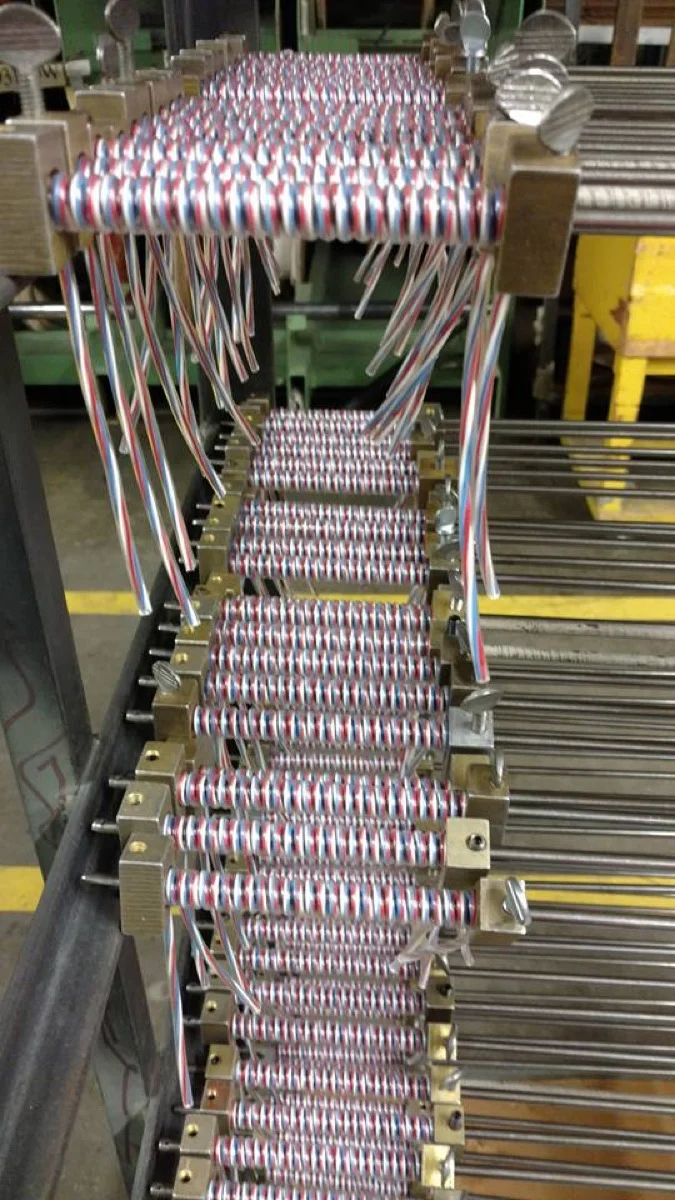
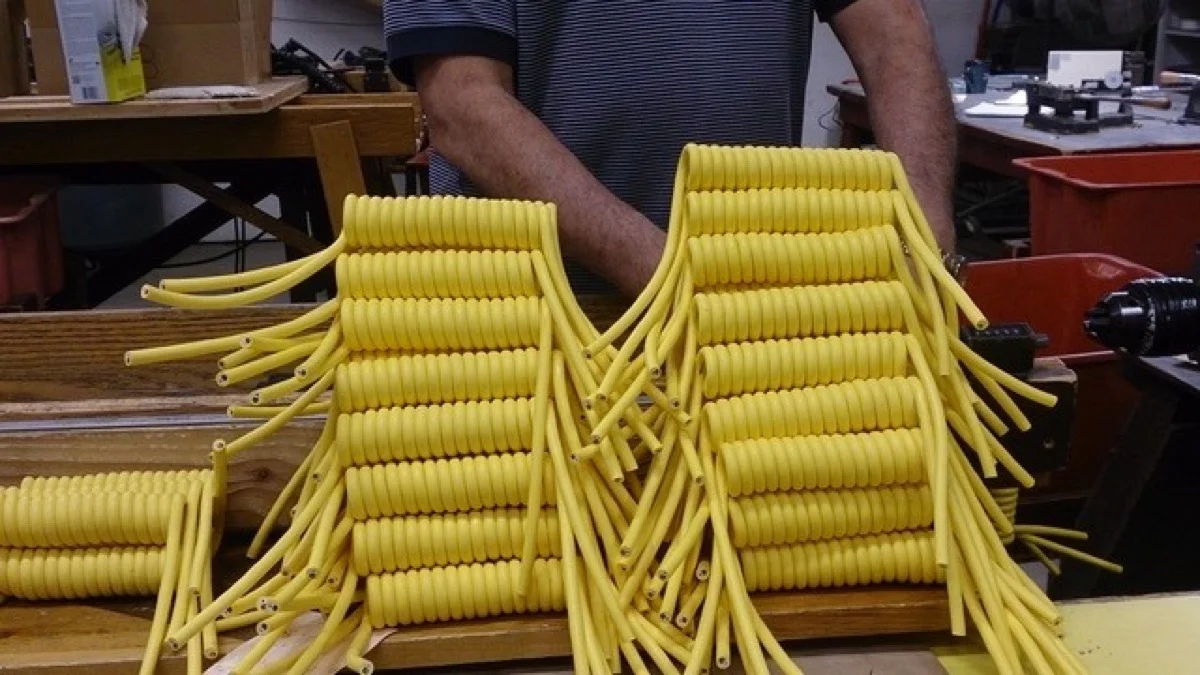
A coiled cord is an electrical cable wound into a helical spring shape that extends under tension and retracts to its compact resting length when released. The helical geometry is permanently heat-set into the jacket material during manufacturing, giving the cord elastic spring memory without any moving parts. A typical coiled cord extends to roughly five times its retracted length and returns automatically when the load is removed.

The product spans an enormous range of applications. The same coiled-cord geometry that carries milliamps on 26 AWG signal lines is also used for 600-volt, 30-amp portable power on 10 AWG conductors. What unifies them is the self-retracting behavior the helical construction produces — the cord stays out of the way when it isn't needed and reaches when it is.

How Coiled Cords Differ from Standard Cables

A regular cable has to be coiled and uncoiled by hand and stays where you leave it. A coiled cord retracts on its own, eliminating tangles and trip hazards at the workbench, on a vehicle dash, or alongside a piece of moving equipment. Beyond convenience, coiled cords also handle repeated flex cycles better than straight cable. The helical geometry distributes mechanical stress along the entire coil rather than concentrating it at fixed bend points, which is why coiled cords are specified for portable equipment, robotic arms, retracting tool stations, and medical devices that move thousands of times over their service life.

Construction: Conductors, Insulation, Jacket, Shield

Every Autac coiled cord is built up from four engineered layers:

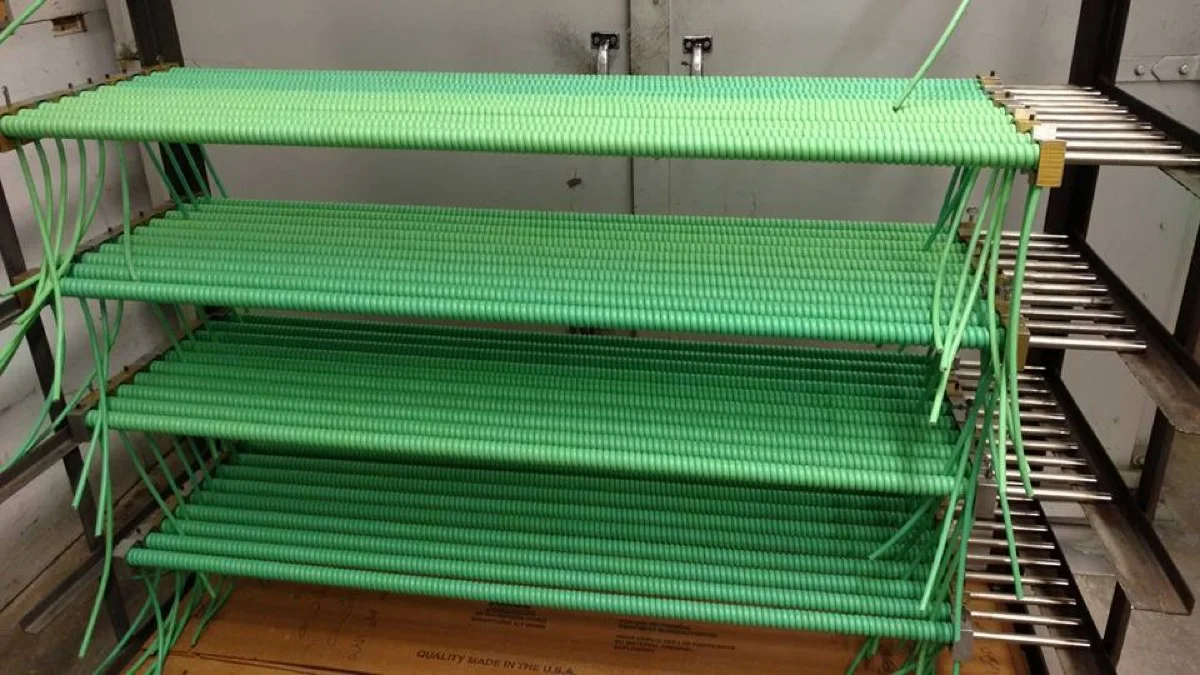
The cord is then heat-cured around a mandrel to set the helix geometry permanently. The result is a cable that retracts to a defined length and returns to that length cycle after cycle, for the life of the cord.

Where Coiled Cords Are Used

Autac coiled cords appear in environments where standard cable would tangle, snag, or fail prematurely under repeated flex. The categories below cover the bulk of OEM and industrial demand we see.

Industrial Equipment

Portable test instruments, hand-held controllers, retractable tool stations, and pendant cables on manufacturing equipment.

Medical Devices

Hospital cart cabling, patient monitor leads, and shielded signal lines for diagnostic imaging and instrumentation.

Telecommunications

Dispatch radio handset cords, headset cables, and shielded data lines in EMI-heavy operations centers.

Transportation & Defense

Vehicle-mounted communications, shielded sensor lines, and retractile power cables for mobile platforms.

Test & Measurement

Probe cables, instrument interconnects, and signal-grade shielded lines where induced noise corrupts readings.

OEM Custom Builds

Built-to-spec cords with custom terminations, jacket colors, conductor counts, and lengths — no minimum order quantity.

Shielded Communications Cables

Tinned-copper coiled cables with a shield for signal and data runs where EMI would otherwise couple into the conductors. TPE insulation and jacket.

Conductor: Tinned copper Insulation: TPE Jacket: TPE Listing: UL Listed Shielding: Shielded Stock: 2 part numbers
Cat. No. Cond. AWG UL Type Voltage Amps Retracted Lengths Listing
7701 3 18 SJTO 300V 5A 2", 4", 6", 8", 10" UL Listed
7710 4 16 SJT 300V 8A 2", 4", 6", 8", 10", 15" UL Listed
PVC Shielded Cables

Shielded PVC coiled cables for instrumentation and control circuits in electrically noisy environments.

Conductor: Tinned copper Insulation: PVC Jacket: PVC Listing: UL Listed Shielding: Shielded Stock: 1 part number
Cat. No. Cond. AWG UL Type Voltage Amps Retracted Lengths Listing
8801 2 18 SVT 300V 5A 2", 4", 6", 8" UL Listed
Miniature PVC Cords

Small-diameter coiled cords for handheld devices, panel wiring, and any assembly where a standard power cord will not fit.

Conductor: Bare copper Insulation: PVC Jacket: PVC Listing: UL Recognized Stock: 2 part numbers
Cat. No. Cond. AWG UL Type Voltage Amps Retracted Lengths Listing
9901 2 18 SVT 300V 5A 2", 4", 6" UL Recognized
9910 3 18 SVT 300V 5A 2", 4", 6", 8" UL Recognized
Miniature PVC Foil-Shielded Cords

Miniature coiled cords with foil shielding, for low-level signal runs inside tight enclosures.

Conductor: Tinned copper Insulation: PVC Jacket: PVC Listing: UL Recognized Shielding: Shielded Stock: 1 part number
Cat. No. Cond. AWG UL Type Voltage Amps Retracted Lengths Listing
9950 3 18 SVT 300V 5A 2", 4", 6" UL Recognized

Don't See Your Exact Spec?

We build custom coiled cords to order — any gauge, conductor count, length, shielding, and color.

Build Your Cord →

How to Specify a Coiled Cord

Most coiled cord inquiries stall in the same place: the application is clear but the cord is not described in terms a manufacturer can quote from. Six values cover almost every build. Send those and we can price a stock catalog number or a custom run without a round of questions first.

1. Retracted Length

The resting length of the coiled section, measured from the end of one lead to the start of the other. This is the number that determines how much cord is out of the way when the equipment is idle. Autac stocks retracted lengths of 2, 4, 6, 8, 10, 15, and 20 inches, and cuts custom lengths outside that range.

2. Extended Working Length

How far the cord actually has to reach in service. A heat-set coil extends to roughly five times its retracted length, so a 10 inch coil gives about 50 inches of working reach. Specify the reach you need rather than the coil you think you need, and we will work backwards to the retracted length. Sizing a coil to its absolute limit shortens its life; the cord should reach its working distance with tension left in it.

3. Conductor Count and Gauge

The stock catalog runs 2 to 4 conductors in 10 through 18 AWG, which covers most portable power and control applications. Custom builds run from 26 AWG signal conductors up to 10 AWG for heavy power, in counts to 25. Conductors are bare copper on power cords and tinned copper on communications, control, test lead, and shielded constructions.

4. Voltage and Current

Stock cords are rated 300V or 600V, carrying 5A to 30A depending on gauge and construction. UL types in the catalog include SVT, SVTO, SJT, SJTO, SO, SOW, and CMG. If you are working to a specific UL type, name it; that single value often settles the jacket, insulation, and voltage rating at once.

5. Jacket Material

TPE, TPR, or PVC, covered in detail below. If the cord will see oil, solvents, sustained cold, or heavy abrasion, say so here rather than leaving it to be discovered in the field.

6. Shielding and Terminations

Shielding is specified when the cord carries signal alongside anything electrically noisy. Autac stocks both braided and foil shielded constructions with a drain wire. Terminations are the last question: molded plug, bare leads for OEM assembly, or a connector you supply or name.

UL Listed or UL Recognized?

Both appear in the catalog and the difference matters at approval time. A UL Listed cord is certified as a finished product and can stand alone in the field. A UL Recognized cord is a component certified for building into a larger assembly that carries its own approval. Bare-end power cords, test leads, and the miniature constructions are Recognized; most finished power cords are Listed.

Jacket and Insulation Materials

The jacket compound does more than protect the conductors. It is the material the helix is heat-set into, so it governs how well the cord holds its coil over thousands of cycles, how it behaves in cold, and what it survives being dragged across. Autac builds coiled cords in three stock families plus its own thermoset compound.

TPE

A thermoplastic elastomer, and the default for flexible-duty coiled cords. TPE stays supple at low temperature, recovers its coil well, and takes repeated flexing without the jacket work-hardening. Autac stocks TPE in power cords, bare-end power cords, and shielded communications constructions, rated 300V.

TPR

A thermoplastic rubber, tougher than TPE and the choice where the cord is dragged, pinched, or exposed to oils. Autac stocks TPR power cords in 12 to 16 AWG, 3 conductor, at both 300V and 600V, carrying 13A to 20A. If a cord is failing on abrasion rather than on conductor fatigue, this is usually the move.

PVC

The general-purpose and most economical option, and the broadest part of the catalog. PVC covers stock power cords from 10 to 18 AWG at 300V and 600V up to 30A, communications and control cables, test leads, shielded cables, and the miniature constructions. PVC is the right answer for indoor equipment in a controlled environment; it stiffens in cold more than TPE does, so it is the wrong answer for outdoor or refrigerated service.

Auta-Prene

Autac's proprietary thermoset compound, developed for coil memory first. It holds its retracted length over a longer service life than a thermoplastic jacket, resists chemicals, and has a low coefficient of friction so the cord slides through fixtures and guides instead of snagging on them. It is specified where the cord is a wear part on equipment that has to keep running.

Choosing Between Them

In practice the decision follows the environment, not the electrical spec. Controlled indoor use goes to PVC. Cold, constant motion, or a cord that must recover its coil precisely goes to TPE. Oil, abrasion, and rough handling go to TPR. Long-service applications where the coil itself is the critical feature go to Auta-Prene. If you are unsure, describe where the cord lives and how often it moves, and we will specify the compound.

Coiled Cord Questions

A coiled cord is an electrical cable wound into a helical spring shape that extends under tension and retracts to a compact resting length when released. The helix is heat-set into the jacket material during manufacturing, giving the cord elastic spring memory without any moving parts. A typical coiled cord extends to roughly five times its retracted length and returns automatically when the load is removed.
A regular extension cord is a straight cable that has to be coiled and uncoiled by hand. A coiled cord retracts to its compact resting length on its own, eliminating tangles and trip hazards. Coiled cords also handle repeated flex cycles better because the helical geometry distributes mechanical stress along the entire coil rather than concentrating it at fixed bend points — which is why they are specified for portable equipment, robotic arms, and any application where the cable will move thousands of times over its service life.
Shielded coiled cords block electromagnetic interference (EMI) and radio frequency interference (RFI) from corrupting signal or data transmission. Spiral-wrap or foil shielding with a drain wire provides 90% or greater coverage, which is required in medical imaging, instrumentation, audio recording, dispatch communications, and any environment with motors, fluorescent lighting, or radio transmitters nearby. Without shielding, induced noise can cause sensor drift, data errors, or audible hum on signal lines.
Auta-Prene is Autac's proprietary thermoset rubber jacket compound formulated specifically for retractile cords. It delivers superior coil memory (the cord stays tightly retracted across thousands of extension cycles), high chemical and oil resistance, a wide service temperature range, and a lower coefficient of friction than standard PVC, which means it slides freely through fixtures and does not snag in workshop or manufacturing environments.
Standard Autac coiled cords are available in retracted lengths from a few inches to several feet, with a typical 5:1 extension ratio (a 12-inch retracted cord extends to roughly 60 inches). Conductor gauge ranges from fine 26 AWG signal wire up to 10 AWG power conductors rated at 30 amps and 600 volts. Conductor count runs from 2 through 25, depending on the configuration. For specifications outside the catalog, custom builds are available with no minimum order quantity.
Yes. Autac maintains UL listing on more than 400 standard catalog part numbers, with current listings spanning multiple cord types including SJT, SJTO, SJTOW, SO, SOW, and corresponding signal-cable categories. UL listing is a customer requirement in most industrial, medical, and OEM applications, and Autac maintains the certification with full lot traceability on every cord that leaves the facility.
Yes. Autac builds custom coiled cords to specification with no minimum order quantity. You specify the conductor count, gauge, voltage and current rating, retracted length, extension ratio, jacket compound, color, shielding, and termination type, and Autac handles the design, tooling, and manufacturing. Quote turnaround is typically one to three business days; lead times depend on conductor availability and termination complexity. Start a custom build at Build Your Cord.
Every Autac coiled cord is manufactured at our facility in Branford, Connecticut. We've produced retractile and coiled cords on the same site since 1947 and are the only 100% woman-owned retractile cord manufacturer in the industry. Domestic manufacturing means short lead times for North American customers and full control over quality, lot traceability, and UL compliance.

Related Resources

Need a Coiled Cord Quote?

Tell us about your application and we'll recommend the right cord — or build one from scratch.