Product Category
Curly Cords
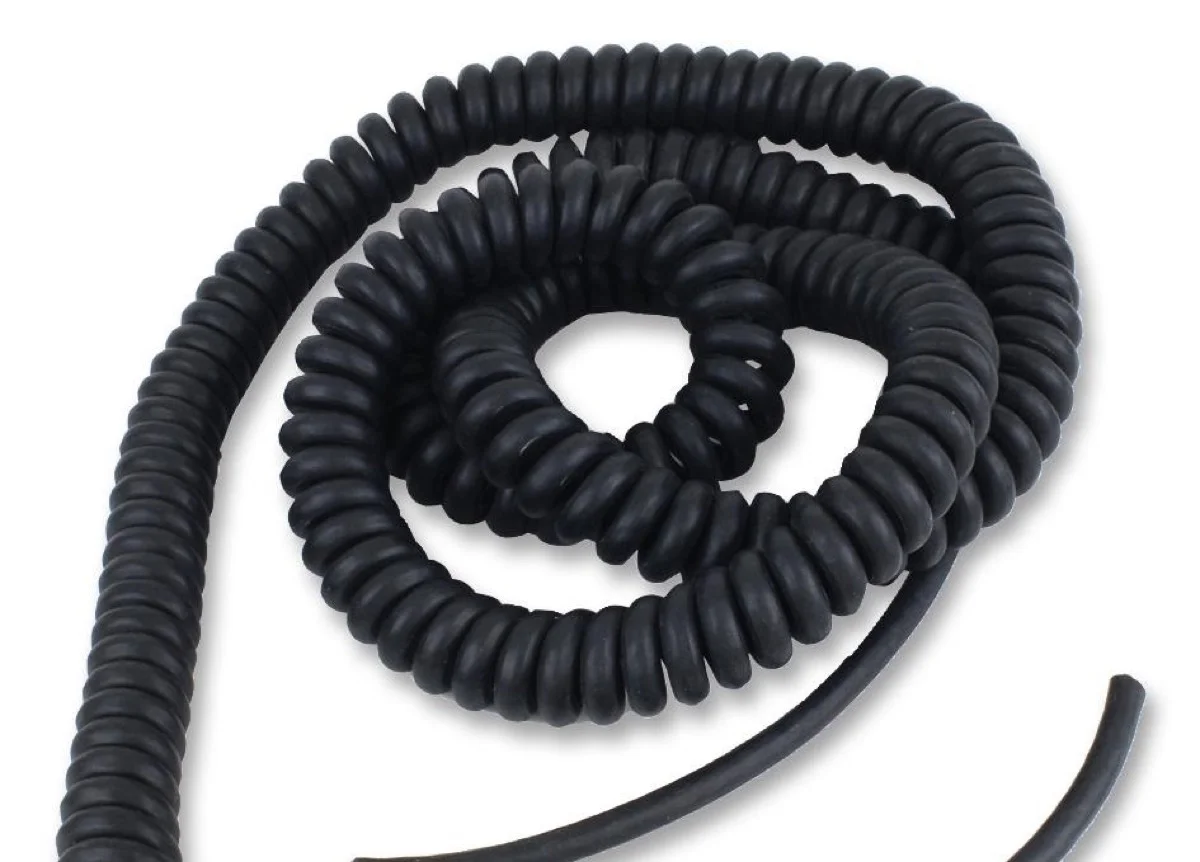
Curly cords for telephone handsets, headsets, dispatch radios, control panels, and test leads: what they are, how the coil is made, the stock catalog, and how to choose one. Manufactured in Branford, CT since 1947.
Why Are Phone Cords Curly?
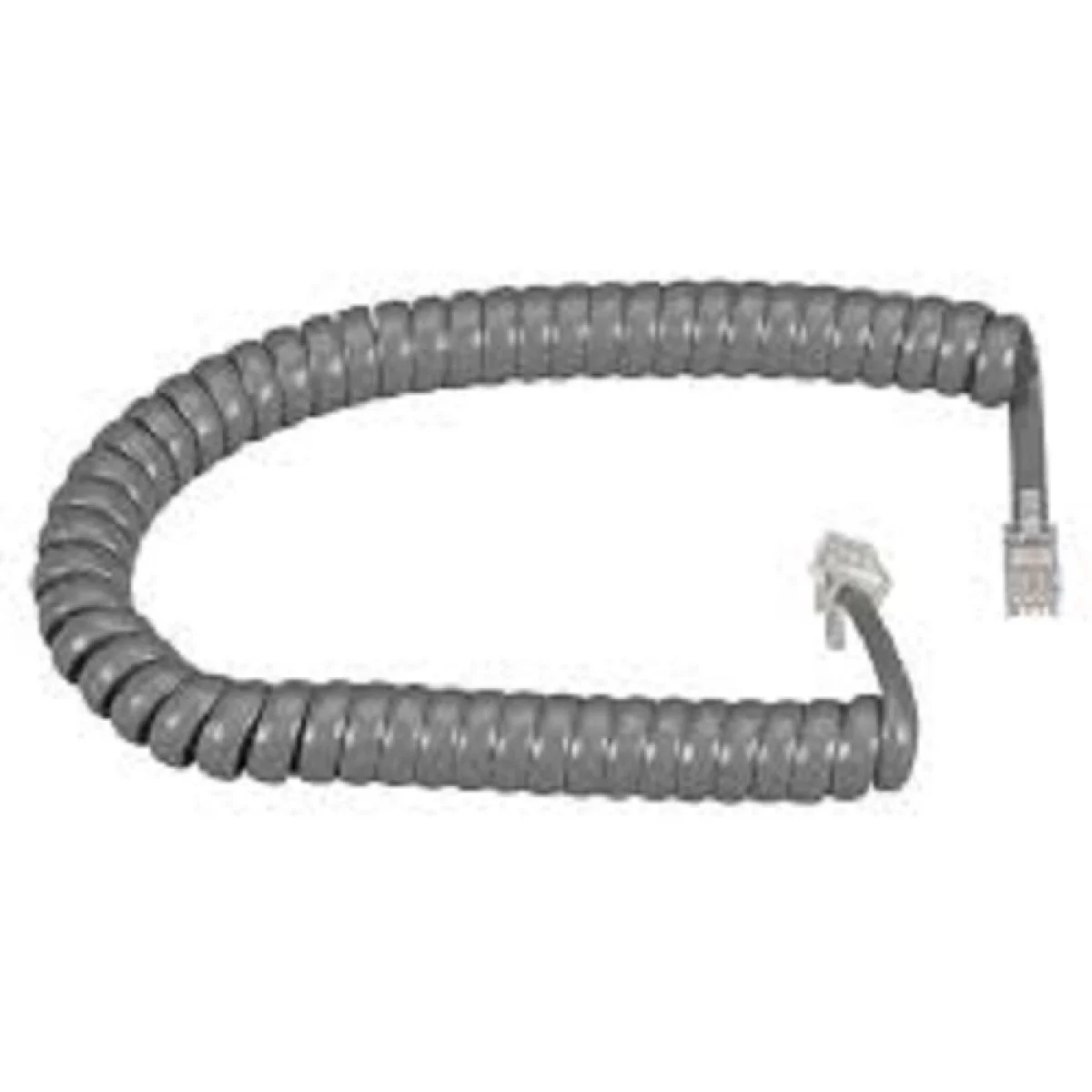
The curly handset cord is one of the most familiar coiled-cable applications in the world — and the engineering reason behind it is the same reason curly cords are used across industrial, medical, and dispatch environments today. A handset has to reach the user's ear from a base station and return to a compact resting state when not in use. A straight cord either has to be too short to be useful or constantly tangled across the desk. The helical coil solves both problems simultaneously: it extends to several times its retracted length under tension and pulls itself back into place when released.
Curly cords are manufactured by winding straight insulated cable around a heated mandrel, then heat-curing the jacket compound at controlled temperature and time. The cure permanently sets the helix into the molecular structure of the jacket — not as a temporary deformation but as the cable's new resting shape. The same heat-set process Autac has refined since 1947 produces every Autac curly cord, from a 23 AWG telephone handset cord to a 15 conductor dispatch console cable.
When to Call It a Curly Cord
Curly cord is the term that sticks to a specific picture: a handset tethered to a base, a headset on a dispatch console, a test lead on a utility meter. It is consumer and operator language, and it is the right word when the cord is short, light, and attached to something a person picks up and puts down all day.
The same helical construction goes by other names elsewhere in the industry, and Autac splits its catalog along those lines so you land on the right stock range. If your requirement is specified by wire gauge, conductor count, or shielding, that is a coiled cord. If you are working from a UL product category or need the full stock and custom range, that is a retractile cord, which is the formal term UL uses for the whole family.
How the Curly Shape Is Made
A curly cord does not start out curly. It begins as a straight length of insulated cable, identical in construction to any conventional cord, and the helix is added in four steps:
- Winding. Straight cord stock is wound tightly around a steel mandrel at a controlled pitch. The pitch sets the coil's outside diameter and how tightly the turns pack together.
- Heat setting. The wound mandrel goes into an oven at a temperature and time matched to the jacket compound. The cure restructures the jacket at the molecular level and sets the helix permanently.
- Cooling and removal. The cord cools on the mandrel, then comes off holding its coil on its own. From then on it returns to that shape after every stretch.
- Termination. The straight sections at each end, the tangent leads, are left uncoiled for strain relief and for the plug, connector, or bare-wire ends. Stock cords carry 12 inch leads on a 12 inch coil and 6 inch leads on the 24, 36, and 48 inch coils.
The quality of the heat set is what separates a cord that holds its coil through tens of thousands of cycles from one that sags inside a few months. Autac has refined the cure for every jacket compound it runs since 1947.
Curly Cord, Curly Wire, Curly Cable: One Product, Many Names
The name depends on who is talking. End users describe the cord by what it looks like, so curly cord, curly wire, and curly cable all mean the same thing. Engineers, UL, and purchasing departments use the formal terms, and Autac organizes its catalog along the same lines so each name lands on the right stock range.
| Term | Who uses it | Where it lives at Autac |
|---|
| Curly cord, curly wire, curly cable | End users, DIY, everyday searches | This page: handset, headset, control-panel, and test lead cords |
| Coiled cord, coil cord | Manufacturers, distributors, OEM purchasing | Coiled cords: cable specified by gauge, conductor count, and shielding |
| Retractile cord | UL, engineers, specifications and compliance documents | Retractile cords: the UL category and the full stock power range |
| Spiral cord, spiral cable | European markets, automotive and trailer connections | Spiral phone cords: same construction, built from the same catalog |
Whatever you call it, if you are searching for a curly cord you are looking for a retractile cord, and Autac has manufactured them in Branford, Connecticut since 1947.
Where Curly Cords Are Used Today
Despite the rise of mobile devices, curly handset cords and other curly-cord applications remain critical infrastructure across half a dozen industries. Reliability, signal integrity, and the ability to disinfect or service a fixed cord matter more than mobility in these environments.
Healthcare & Hospitals
Patient room phones, nurse stations, and medical-cart handsets. Antimicrobial PVC jackets meet healthcare cleaning protocols.
Hospitality
Hotel guest-room phones, bell desks, and front-desk operations. Long service life and a familiar user experience for guests of any age.
Call Centers & Operations
Multi-line phone systems, headset cables, and dispatch consoles where 24/7 reliability is non-negotiable.
Emergency Dispatch
911 dispatch handsets, public safety radios, and fire/police/EMS communications. Shielded options block radio interference.
Industrial Control Panels
Pendant controls, hand-held programming terminals, and machine operator stations on the factory floor.
Test & Measurement
Auta-Prene test leads for utility meters, multimeters, and field instruments. Flexes reliably in cold and oily environments.
Manufacturing & Assembly
Handheld tools, torque wrenches, and barcode scanners tethered to fixed workstations. The cord retracts clear of conveyors and foot traffic when the tool is set down.
Retail & Point of Sale
Barcode scanners, payment terminals, and customer displays at the checkout. Miniature curly cords keep counter space clean without adding bulk.
Audio, Video & Broadcast
Studio headphones, microphones, and camera tethers. Shielded curly cords keep signal clean next to power lines and other interference sources.
Automotive & Transportation
Diagnostic scanners and handheld testers that reach around a vehicle, and coiled cable bridging the articulation gap between a cab and its trailer.
Government & Federal
Secure facility phones, tactical communications, and federal procurement contracts. WBENC-certified woman-owned supplier.
OEM Custom Builds
Built-to-spec curly cords with custom terminations, jacket colors, and conductor counts for medical, AV, and specialty equipment.
Handset Cords
The handset cord is the curly cord most people picture, and it is still the highest-volume curly application Autac builds. It runs from the base of a telephone or dispatch console to the handset itself, and it has to survive being stretched across a desk, dropped, wound around a wrist, and pulled taut thousands of times a year without the coil going slack or a conductor breaking at the strain relief.
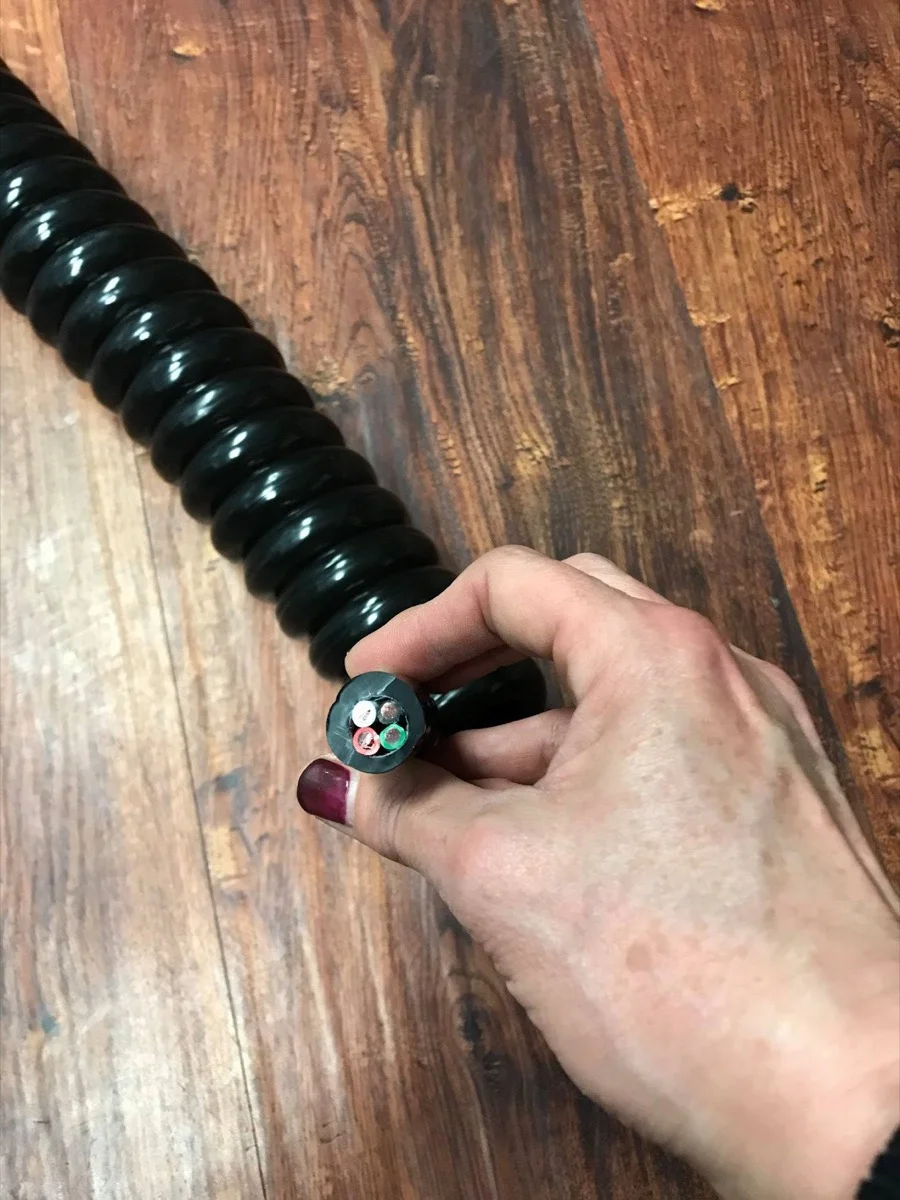
Autac stocks the communications and electronic control construction these cords are built on: 2 to 15 conductors of 23 AWG stranded tinned copper on polypropylene insulation, with a PVC jacket (catalog numbers ending in 5P) or an Auta-Prene TPE jacket (ending in 7P), rated 300V at 1A and 80°C, in retracted lengths of 12, 24, 36, and 48 inches. Tinned copper matters here more than gauge does. A handset cord fails from flex fatigue at the terminations long before it fails from current, and tinning protects the strands where the cord bends hardest.
Choosing a Length
Specify the reach across the desk, not the coil. A curly cord extends to roughly five times its retracted length, so a 12 inch retracted cord gives about 5 feet of working reach and a 24 inch cord about 10 feet. Sizing the coil so it reaches its working distance with tension still left in it is what keeps the cord recovering; a cord routinely stretched to its limit will take a set and stop retracting.
Replacement or OEM Run
For a one-off replacement, match the conductor count and the terminations on the cord you are replacing. For an OEM program, send the conductor count, gauge, retracted and extended length, jacket color, and the connector on each end, and we will quote the run. Autac terminates to the connector you specify rather than to a fixed house standard.
Curly Test Lead Cords
Test leads are the other half of the curly range and behave differently from handset cords. The cord spends its life being uncoiled to a meter, stretched to an awkward measurement point, and dropped back into a bag, often outdoors and often cold. What it needs is jacket flexibility and coil recovery rather than conductor count.
Autac stocks Auta-Prene test leads as a single-conductor construction: 20 AWG stranded tinned copper with TPE insulation and an Auta-Prene TPE jacket, rated 5000V at 4A and 105°C, in 12 and 24 inch retracted lengths. These are UL Recognized rather than UL Listed, which is the correct designation for a component built into an instrument or lead set that carries its own approval. If you need a finished, standalone listed cord, say so at quote time and we will move you onto a Listed construction.
For utility metering and field test work where the lead is handled constantly in the cold, Auta-Prene is the jacket to ask about. It stays flexible at low temperature and holds its coil over a longer service life than a thermoplastic jacket will.
Types of Curly Cords
Curly cord is a category, not a single product. The helix is the same on every one; the construction underneath it changes with the job. Autac stocks five constructions, and each lives on the page its buyers search for.
Communication and Control Curly Cords
The handset cord and its relatives: 2 to 15 conductors of 23 AWG tinned copper, built to carry voice, data, and control signals on telephones, dispatch consoles, headsets, intercoms, and operator stations. This is the range in the table above.
Test Lead Curly Cords
Single-conductor 20 AWG leads rated to 5000V for meters and probes, jacketed in Auta-Prene TPE. Also stocked on this page.
Power Curly Cords
Curly cords that carry line voltage to tools and equipment: 12 to 18 AWG, 2 to 10 conductors, in UL-listed SJT, SJTOW, SEOW, and SVT constructions at 300V and 600V, with TPE, TPR, or PVC jackets. Autac catalogs these under the UL term, retractile cords.
Shielded Curly Cords
For signal that runs next to anything electrically noisy: medical instruments, audio, industrial automation. Autac stocks served shields applied to each conductor or overall, and foil-shielded miniature cords, at 23 and 28 AWG. They are cataloged under coiled cords.
Miniature Curly Cords
28 AWG, 2 to 10 conductors, for barcode scanners, handheld instruments, and any enclosure a standard cord will not fit. Also under coiled cords.
What Makes a Curly Cord Hold Its Coil
Every curly cord relaxes over its life. How fast it happens is a manufacturing question, and it is most of the difference between a cord that lasts a decade and one that hangs slack inside a year.
The Coil Is Heat-Set, Not Wound
The helix is formed around a mandrel and then heat-cured into the jacket compound, which is what gives the cord spring memory with no moving parts. A cord that was formed without a proper cure, or cured at the wrong temperature for its compound, will look identical on day one and take a permanent set within months. This is the single most common reason a cheap replacement handset cord goes slack quickly.
Jacket Compound
PVC is the stock jacket across the curly range and is the right choice for indoor equipment in a controlled environment. It stiffens in cold, so for outdoor, refrigerated, or field-test service the answer is a more flexible compound. Auta-Prene, Autac's own thermoset, is specified where coil recovery over a long service life is the point of the cord rather than a nice-to-have.
Strain Relief at the Terminations
Most curly cords fail where the coil meets the lead, not in the middle of the coil. The transition concentrates every pull the user applies into a short length of cable, so the termination has to relieve that strain rather than clamp it. Where a cord is failing at the plug rather than going slack, the fix is the termination and the lead length, not the coil.
How Far It Is Stretched
The specification decides this as much as the user does. A cord sized so its working reach sits well inside its extension range recovers indefinitely; one sized to just barely reach is being pulled to its limit on every use and will take a set. When a cord is going slack in service, check the reach it is being asked for before changing the cord.
How to Choose the Right Curly Cord
With hundreds of possible configurations, picking the right curly cord comes down to seven practical questions about the application:
- What are you connecting? The device's voltage and current set the minimum gauge and cord type. A handset needs 23 AWG signal conductors; a 15 amp power tool needs 14 AWG.
- How far does it need to reach? Measure the working distance and divide by five for the retracted coil length. Stock coils of 12, 24, 36, and 48 inches reach 5, 10, 15, and 20 feet, plus the tangent leads.
- What is the environment? PVC (catalog numbers ending in 5P) for indoor, climate-controlled service. Auta-Prene TPE (ending in 7P) for cold, chemical exposure, or heavy handling. For outdoor power, the W-rated TPE and TPR jackets on the retractile cords page.
- Do you need shielding? If the cord runs near motors, drives, or RF equipment, or carries medical, audio, or data signals, specify a served or foil shield.
- How many conductors? Stock communication cords run 1 to 15 conductors at 23 AWG, miniature cords 2 to 10 at 28 AWG, and power cords 2 to 10 at 12 to 18 AWG. Count every signal and power path you need.
- What connectors? Modular jacks, NEMA plugs, IEC connectors, circular connectors, or stripped and tinned bare leads. Specify each end.
- Stock or custom? The stock catalog runs 112 catalog numbers across ten constructions, over 400 part numbers once each is counted in its four retracted lengths. Outside that, Autac builds to your specification, with no minimum order quantity on most constructions.
Wire Gauge and Current, Stock Range
| Wire gauge | Stock amp rating | Common use |
|---|
| 12 AWG | 12A to 20A | Heavy power tools, industrial machinery (TPR and PVC power cords) |
| 14 AWG | 10A to 15A | Workshop tools, medical carts |
| 16 AWG | 10A to 13A | Light-duty power, small equipment |
| 18 AWG | 5.6A to 10A | Low-draw devices, lamps, chargers |
| 20 AWG | 4A at 5000V | Test leads |
| 23 AWG | 1A, signal level | Handset, headset, control, and shielded cords |
| 28 AWG | 0.5A, signal level | Miniature and foil-shielded cords |
Heavier gauges carry more current but make a stiffer, heavier coil. Lighter gauges give a compact, flexible curly cord suited to signal work. Every stock number, with stranding, temperature rating, and coil diameter, is on the full catalog.
Why Buy Curly Cords Direct from the Manufacturer
Autac engineers and manufactures every curly cord it sells, in one plant in Branford, Connecticut. Buying direct matters for a few concrete reasons:
- Quality control. Every cord is wound, heat-set, and terminated under one roof, and tested for coil memory, electrical performance, and jacket integrity before it ships.
- Customization without the markup. Gauge, conductor count, length, jacket compound, color, and termination can all change on a custom run, with no distributor in the middle.
- Engineering support. The people quoting the cord are the people who understand the trade-offs between flexibility and durability, extension ratio and recovery force, shielding and coil diameter.
- Made in the USA. Shorter lead times, direct communication, and compliance with domestic sourcing requirements for government and defense work. CAGE code 3AWW0.
- Woman-owned. Autac is 100% woman-owned, which qualifies it for supplier diversity programs and WBENC-recognized procurement.
Whether you call them curly cords, curly wire, curly cable, coil cords, or retractile cords, Autac has been making them longer than anyone else in the business.